

There’s something oddly satisfying about unlocking hidden performance in a car that already feels complete. You buy something like an Audi RS6 or a Mercedes-AMG GT63 thinking, “This is it. This is peak engineering.” And yet… a few subtle changes later, the whole personality shifts. Sharper, louder, more alive. It’s not about turning these machines into something else — it’s about letting them breathe the way they probably wanted to from the factory.
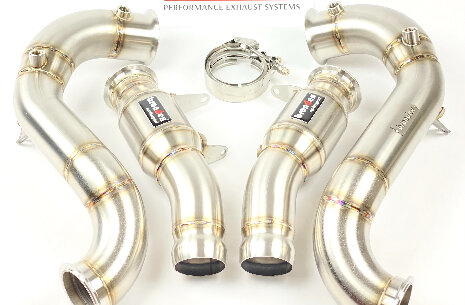
One of the most talked-about upgrades in this space is the humble (well, not so humble) downpipe.
Why Downpipes Even Matter
At a glance, a downpipe doesn’t look like much. It’s just a section of piping that connects the turbocharger to the rest of the exhaust system. But the role it plays is far from minor.
Factory downpipes are usually designed with emissions, noise regulations, and long-term durability in mind. All reasonable priorities, sure — but not exactly performance-focused. They tend to restrict airflow more than enthusiasts would like, which means your engine isn’t always operating at its full potential.
Swap that restrictive setup with a high-performance downpipe, and suddenly you’re reducing backpressure, improving turbo efficiency, and in many cases, unlocking noticeable horsepower gains. The throttle response sharpens too — that slight delay you didn’t even notice before? Gone.
The RS6 C8: A Wagon That Refuses to Behave
The Audi RS6 C8 is one of those cars that breaks expectations. It’s a family wagon, technically. But put your foot down and it transforms into something almost absurdly aggressive.
Owners who install audi rs6 c8 downpipes often describe the change not just in numbers, but in feel. The car becomes more eager, almost impatient. The turbos spool faster, and the exhaust note — which was already pretty special — deepens into something more raw and mechanical.
There’s a moment, especially during mid-range acceleration, where the car feels like it’s pulling harder than before, almost like it’s shedding weight. That’s the reduced backpressure doing its thing.
Of course, it’s not just about speed. There’s an emotional side to it. The sound alone can make early morning drives feel like an event. Not always neighbor-friendly, admittedly, but undeniably addictive.
Sound, Heat, and the Real-World Trade-Offs
Let’s not pretend upgrades come without compromises.
Performance downpipes typically increase exhaust volume. Sometimes significantly. If you’re someone who values quiet cruising, this might take some adjustment. Cold starts can get especially loud — the kind of loud that makes you wonder if everyone on your street now knows your schedule.
Then there’s heat management. With freer-flowing exhaust gases, temperatures can shift in ways that require attention. Many high-quality aftermarket options include heat shielding or recommend additional thermal protection, which is worth taking seriously.
And, of course, emissions compliance. Depending on where you live, installing certain types of downpipes may not be road-legal. It’s one of those details people tend to overlook until inspection time rolls around.
The AMG GT63 X290: Luxury With a Wild Side
If the RS6 is the stealthy powerhouse, the Mercedes-AMG GT63 X290 is more like a tailored suit with a hidden edge. It’s refined, elegant… until it isn’t.
Upgrading to mercedes gt63 x290 downpipes tends to amplify that dual personality. The car retains its luxury feel in everyday driving, but when pushed, it reveals a more aggressive, almost feral side.
The engine note becomes sharper, more pronounced. You hear the turbo whistles more clearly, and under load, the exhaust takes on a deeper, more commanding tone. It’s not just louder — it’s more expressive.
Performance-wise, the gains are similar in principle to the RS6: better airflow, improved turbo efficiency, and quicker response. But what stands out here is how seamlessly the upgrade integrates into the car’s character. It doesn’t feel like a modification. It feels like a version of the car that was always there, just slightly held back.
Choosing the Right Setup
Not all downpipes are created equal, and this is where things can get a bit nuanced.
You’ll generally come across two main types: catted and catless. Catted downpipes include high-flow catalytic converters, offering a balance between performance and emissions. Catless options, on the other hand, maximize flow but often at the cost of legality and sometimes practicality.
Material quality matters too. Stainless steel is common, but the grade and construction can vary. Weld quality, fitment precision, and heat resistance all play a role in how well the upgrade performs over time.
And then there’s tuning. While some cars can adapt to new downpipes without issue, many benefit from an ECU tune to fully optimize the changes. Without it, you might not be getting the full advantage — or worse, you could trigger warning lights.
Living With the Upgrade
Here’s the part people don’t always talk about enough: daily life after the upgrade.
At first, everything feels exciting. The sound, the responsiveness, the way the car reacts differently. But over time, you settle into it. It becomes your new normal.
Some days, you’ll appreciate the extra punch during an overtake. Other days, you might wish for just a bit more subtlety on a long highway drive. It’s a trade-off, like most things in the automotive world.
Still, for many enthusiasts, it’s absolutely worth it. Because beyond the specs and numbers, there’s a sense of connection that comes from fine-tuning a car to your liking.
Final Thoughts
Upgrading downpipes on high-performance cars like the RS6 C8 or AMG GT63 isn’t just about chasing horsepower figures. It’s about refining the driving experience, making it more personal, more engaging.
It’s not for everyone — and that’s okay. But if you’re the kind of person who notices the small details, who enjoys the subtle differences between “good” and “great,” then it’s an upgrade that can genuinely transform how your car feels.
And sometimes, that transformation isn’t loud or dramatic. Sometimes it’s just a little sharper, a little quicker, a little more alive.
